
App Composer · owner experience
Describe the app.
Get the tools to run it.
Owners need a place to publish, approve, configure, measure and keep their app current. App Composer connects those tools to the application without adding another dashboard to maintain.
Native tools: Needs attention · Workflows · Orders fixture lab
Owner surfaces sit behind the existing Cloudflare Access policy and EmDash roles. Public visitors cannot reach them.

01 / The request
A local club asks for a website and a way to run it.
“Build a local club site with news, a photo wall, links and an enquiry form. I need to approve photos, edit the welcome, see which links people use and keep the app up to date.”
The website needs pages, a welcome message, a place for member photos, useful links and a way for people to get in touch. The owner needs moderation, editing, configuration, a private inbox, a connection check and an honest export.
Each part keeps its existing owner: Init holds the brief and content model, the independent apps own their records and source, EmDash provides the owner interface, and Cloudflare supplies runtime and storage. The result is a composed stack with a public address and a separate owner workspace.
Supported now
- Saved stacks with draft, preview, publish and a shareable revision.
- Here / there photo contributions with pending review, approval and revocation.
- Linkarooie links, profile settings and collection from an approved source.
- A private enquiry inbox owned by the app, with retained-record limits.
- Page-level enquiry counts in the owner Inbox.
- Connection checks and approved-content export for a saved Here / there instance.
- Private workspace outcomes for recorded actions.
Needs configuration
- Each app's title, introduction, theme and declared settings.
- Who may enter the workspace as owner, editor or viewer.
- Whether a public enquiry form is open for a specific publication.
- Which contributions are approved, hidden or featured.
- Whether a stack is a draft, published or archived.
Not supported yet
- General self-service signup and a fresh customer workspace.
- Turning an arbitrary plugin, theme or Drupal site into a working app.
- A native news/pages collection wired into this stack. EmDash content authoring exists; this composed stack does not mount it as a page type.
- Automatic notification dispatch, replies and provider delivery/bounce confirmation for enquiries. The native Inbox can retain notification state; configured manual dispatch is a separate owner action.
- Full media recovery, point-in-time restore or account migration.
- Automatic code changes from a prompt without review and deployment.
02 / Two surfaces
The public app and owner workspace
The public page presents the club, its links and approved contributions. The owner workspace is a separate address behind authentication, with the same app data underneath and no copied records in a second dashboard.
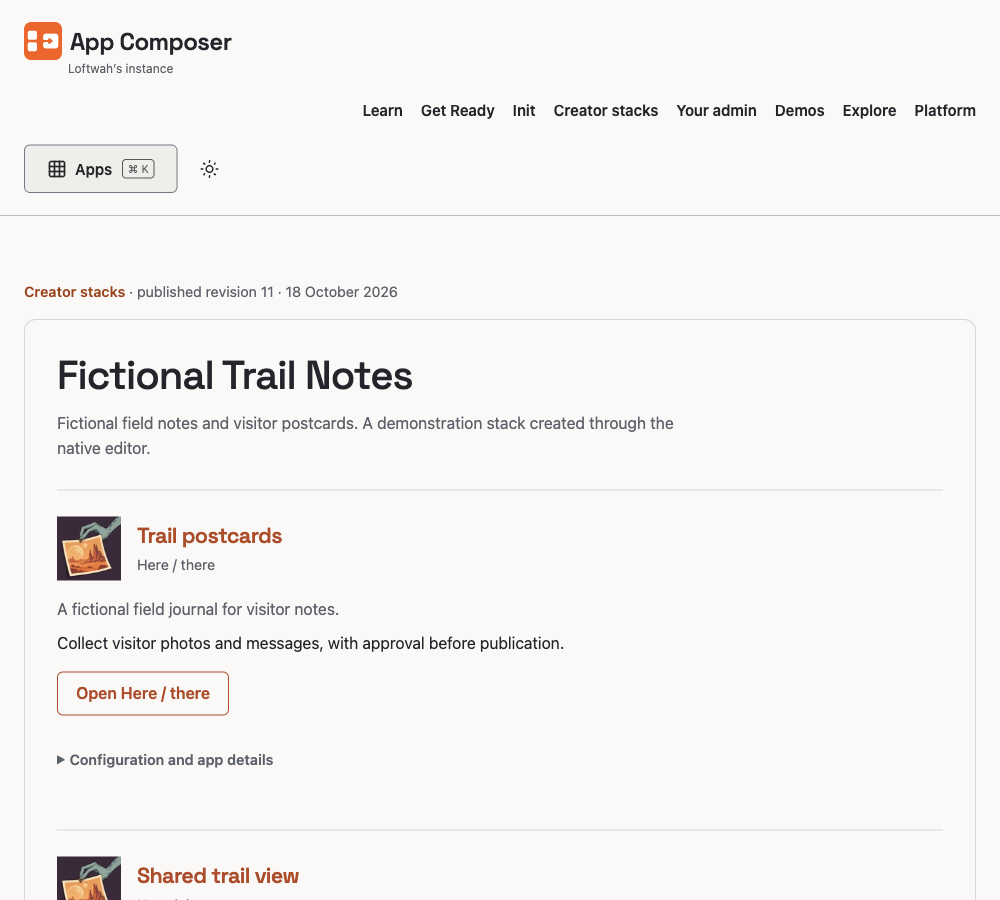
What a visitor can do
- Read a published revision without an account.
- Open a mounted app in the context of the stack.
- Submit a photo or a private brief only when the owner has opened that route.
- Use the page on a phone, with keyboard focus and both supported themes.
A published revision is immutable. Editing the draft does not change what visitors see until the owner publishes again.
What the owner can do
These are the current native surfaces. The Composer pages share the invited-owner Access boundary; app-owned studios keep their own owner authentication. Each surface names the app or workspace it acts on.
- Creator stacksEdit the composition, configure declared app settings, preview, publish, unpublish, archive, duplicate and export configuration.
- Private enquiriesRead retained briefs, mark reviewed or rejected, delete, export, and see counts by published page.
- Workspace outcomesInspect recorded opens and verified moderation transitions, with definitions, caps and missing history stated.
- Workspace maintenanceCheck a saved app connection and prepare an approved-content file with verified PNGs.
- Workspace accessPrepare editor or viewer invitations with expiry. Trusted-account acceptance remains separate.
- App-owned studiosHere / there and Linkarooie keep their own owner routes for photos, links and settings.
03 / The wiring
Each app keeps its data. Composer brokers the work.
The useful admin follows where the records live and who may change them. Here / there owns photo submissions and private media. Linkarooie owns links, featured notes and curation. App Composer owns workspaces, saved stacks, published revisions and the record of approved actions. Each app shares only the fields and actions it declares, so a familiar admin can exist without merging every app into one database.
- Describe and plan. The brief names the app and the owner work. Supported capabilities are separated from unsupported requests.
- Independent apps. Each app keeps its repository, release, records and owner API.
- Scoped bridge. Composer checks workspace membership, the exact publication, source and revision before an action.
- Owner admin. EmDash and the native Composer pages approve, edit, measure and export.
- Public result. A published stack serves the immutable public revision; drafts and owner controls stay private.
04 / The owner journey
From “make it” to “I can run it”.
- 1
Describe the app and the job.
Use Init to capture the purpose, content shape, apps, appearance and deployment intent. The brief is data. It does not grant execution or deployment authority.
- 2
See the plan before the build.
The supported stack is explicit: which apps exist, which settings they declare, which contributions can be moderated and which requested capabilities are still unsupported. A missing capability stays visible rather than becoming a dead menu item.
- 3
Build and wire the real pieces.
The authorised agent works in the independent repositories, verifies their source and tests, then binds a saved stack to the app-owned resources. Composer checks the current source and account before a configuration write.
- 4
Operate from the owner workspace.
Approve a photo, edit a link, change a welcome message, read a private brief, check a connection or prepare an approved-content export. The public page reflects only the published revision.
- 5
Change by describing the next job.
“Show me which page the enquiries came from” becomes a reviewable admin change. “Add moderation” becomes a reviewed app change where the app already supports it. Neither request silently widens permission or deploys unreviewed code.
05 / A second request
“Show me which page the enquiries came from.”
The first version could read one private brief at a time but could not show how many belonged to each published page. The owner Inbox now groups retained briefs by the exact published stack and app instance that delivered them, and shows reviewed, pending and rejected counts beside each page. The change is in Composer's admin; the briefs still live in the app.
Enquiries by page
| Page | Reviewed | Pending | Rejected | Total | Latest |
|---|---|---|---|---|---|
| Fictional Trail Notes · Trail postcardsPublished revision 11 | 2 | 1 | 0 | 3 | 21 Oct |
| Fictional Trail Notes · Shared trail viewPublished revision 11 | 1 | 0 | 1 | 2 | 20 Oct |
| Standalone visitor book | 0 | 1 | 0 | 1 | 19 Oct |
Fictional counts for the demonstration, not customer activity. “Reviewed” means an owner marked the brief. It is not a sale, a contact, a conversion or proof that anyone received a reply. Briefs expire after 30 days; the summary covers up to the 200 records Composer accepts from the export and says when that limit is reached.
App change
The public form belongs to one immutable publication and is opened by the workspace owner. Closing, archiving or replacing that publication closes the route without changing a separate standalone form.
Admin change
The Inbox asks the app for the retained export, validates the resource and source, and counts by provenance. It returns no submitted text, contact field or visitor identity in the summary.
06 / Analytics proof
From “show me what works” to a shareable public record.
A plain-language request can ask for the activity that matters without asking for a visitor identity: which app was opened, which supported task finished, and whether a note reached review. The current path uses the existing Guestbook contribution contract, Composer's bounded counters and the owner outcomes report. It does not add a second analytics vendor or a parallel dashboard.
- 1
Describe the useful outcome.
“Show contribution-page opens and postcards that reached review. Keep the same period in my owner report, and let me share a public summary.”
- 2
Use the supported contract.
Guestbook owns the contribution page, the pending record and its review state. Linkarooie owns the exact source reference and featuring choice. Composer records only the declared app events; private briefs, visitor identity and enquiry text stay out.
- 3
Inspect the owner result.
Workspace outcomes shows recorded app Opens and verified approval, hide and deletion transitions for the selected stack, with a previous window, definitions and missing-history states. Public app totals remain a separate measure. An owner can also explicitly preview and permit the supported Open-action aggregate from this exact context.
- 4
Freeze the public story.
The preview page shows the exact app, signal, period, coverage and daily values before anything is stored. Creating it writes one allowlisted aggregate snapshot on Composer's origin, with landscape, square and portrait images and a route back to the app or Init.
One deployed check on 23 October 2026 followed a normal Open action from a fictional stack into its stored demonstration event. The same workspace, stack and app-instance report changed from one to two Open actions in its seven-day window. The owner then reviewed the exact aggregate and explicitly permitted a public snapshot: two recorded Open actions, on 18 and 23 October. Private record bodies, identities and workspace names are excluded. This verifies the path; demonstration traffic is not organic adoption.
Supported now: recorded app opens, Guestbook contribution-page opens, pending guest postcards after committed acceptance, completed Link Check inspections, private owner outcomes and frozen public snapshots. Not yet: unique people, sessions, a person-level funnel, enquiry-to-revenue attribution, or a public report derived automatically from private records. A snapshot is a lower bound, not proof of demand.
07 / What is proved
Look at the live pieces, then read the limits.
What this does not prove
- A new person can sign up, create a workspace and deploy a customer app without an operator.
- Every WordPress, Drupal or arbitrary plugin feature has an equivalent.
- A private brief was answered, notified or converted into work.
- All app records and media can be restored after loss. Approved-content export is a bounded copy, not a backup.
- Physical-device, screen-reader, native social unfurl or external-provider acceptance.
The earlier administration screenshots remain available as historical production evidence. They are dated; this page describes the current surfaces rather than presenting an old capture as today's UI.
Start with the useful part
Describe what you need to run.
Start with Get Ready if the environment is not ready. Use Init when the app and its owner work are clear. Continue into Creator stacks when the pieces should become one published result.