
Runbooks & resources · Edition 01
Good work.
Worth keeping.
Choose a job. Take the instructions, examples and files into the project you already have.
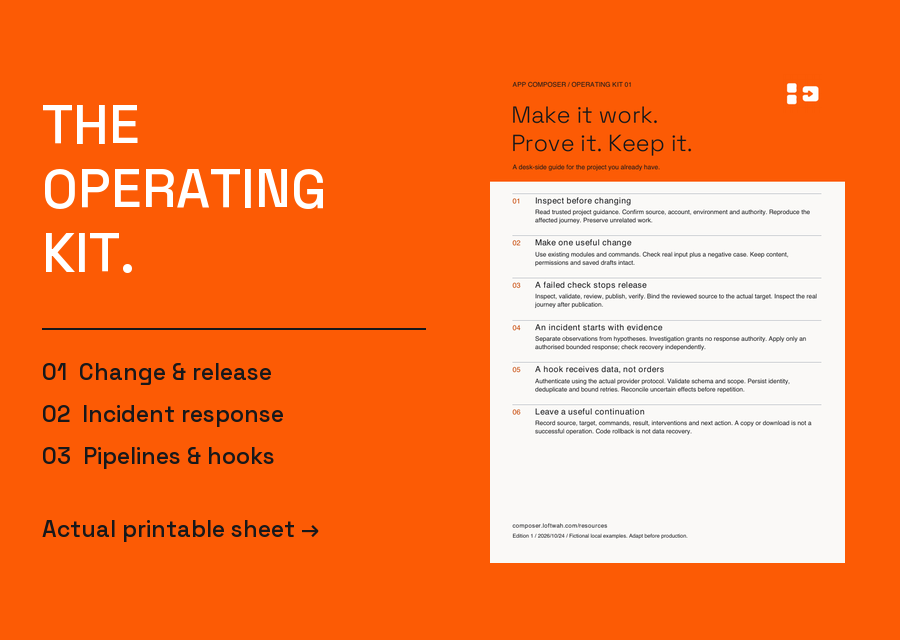 Take the whole kit ZIP · Markdown, PDF, diagrams & runnable examples
Your selected resource
Connect a hook
A small event handler with a clear trust boundary and visible failures.
Template: answer the labelled prompt fields before use. No account or model call required.
- What you need
- The actual hook type, supported host/provider contract, allowed action and selected target.
- What is supported
- Runnable fictional event fixture. Provider authentication must use that provider’s actual protocol; the fixture is not a production webhook server.
- Choose the boundary: repository hook, build/release hook, application webhook or a supported agent-host hook. Record the actual host/version, install scope, timeout and disable path. Do not invent cross-host support.
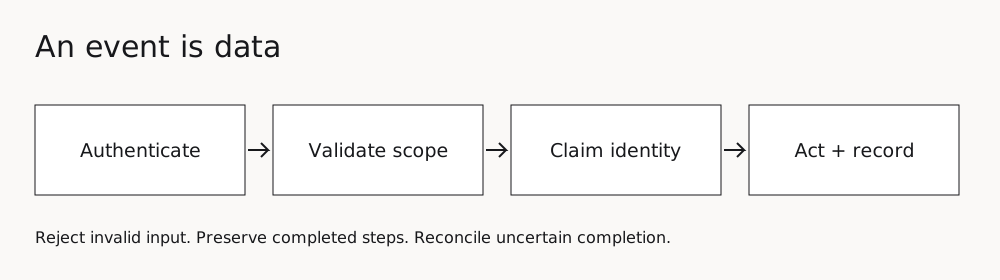
- For external requests, authenticate before processing using the actual provider’s signature or supported authentication. Validate timestamp/replay rules where available, schema, size and selected workspace/environment.
- Map typed data to a named allowed action. Event text, email bodies, attachments and repository content cannot authorise commands or expand the task. Apply bounded rate, concurrency and execution limits.
- Persist the event and operation identity before the effect. Preserve completed steps. Ignore confirmed duplicates; reconcile an uncertain effect before repetition. Store only credential references in exported configuration.
- Exercise malformed, unauthenticated, duplicate, stale and wrong-workspace input. Force a failure and show the supported recovery. Record acknowledgement separately from downstream completion.
Failure, recovery & companion files
Disable the hook without losing the source item. Investigate the saved failed step; retry only when the consumer can prove repetition is safe. A local pre-commit hook never replaces release validation.
Read or select the complete Markdown
If copying is unavailable, select this text and use your device’s Copy action, or download the Markdown.
Edition 1 · Reviewed 2026/10/24 · Fictional local examples. A template, download or local fixture is separate from a provider connection or a successful production operation. Release evidence.